It is small, but it can cause major damage: the Brown Marmorated Stink Bug (BMSB) has been one of the main challenges for hazelnut farming in Georgia since it first appeared in the country in 2017. For thousands of farming families, a severe infestation can lead to significant crop losses.
The situation is particularly challenging for organic farming. While conventional hazelnut production often relies on chemical crop protection products, these are not a suitable option for organic producers. Effective methods are therefore needed that are compatible with the requirements of organic farming.
This is exactly where a joint project by Pakka Foundation, Pakka Georgia and NCC comes in. The project «Enhancing Georgia’s Agricultural Competitiveness: Sustainable Hazelnut and Almond Agroforestry in Kakheti and Samegrelo» runs from July 2025 to June 2028 and is funded by the Austrian Development Agency (ADA) with EUR 650,000 as part of International Partnerships Austria.
An important part of the project is collaboration between different stakeholders. Challenges such as the Brown Marmorated Stink Bug cannot be solved by a single organisation alone. Farmers, researchers, public institutions and the private sector need to combine their knowledge and experience. Pakka Georgia therefore works closely with the National Food Agency (NFA), the Rural Development Agency (RDA) and the Organic Hazelnut Farmers’ Association «CaucasNut».
Which traps work best?
Together with the National Food Agency, Pakka Georgia is testing different methods to control the Brown Marmorated Stink Bug in organic hazelnut production. For this purpose, Pakka Georgia has produced and installed special traps. The National Food Agency provides the pheromones needed for the trials. These attractants draw the stink bugs towards the traps, allowing them to be captured in a targeted way.
The current trial compares different trap designs and configurations. The aim is to identify methods that are particularly effective while also being suitable for organic hazelnut production. The tests are being carried out in Samegrelo and Kakheti.
The experiment is scientifically supported by two Georgian experts: Prof. George Japoshvili from the Agricultural University of Georgia and Prof. Maka Murvanidze from Ivane Javakhishvili Tbilisi State University. They advise the project team throughout the trial period.
Turning knowledge into practical solutions
This example shows how important collaboration is for sustainable agriculture. Scientific knowledge alone is not enough: it also needs to be tested under real-life conditions and translated into solutions that farmers can use in practice.
By working together, the project is generating insights that can help organic hazelnut farmers better protect their crops against the Brown Marmorated Stink Bug. At the same time, it contributes to strengthening the long-term resilience of Georgia’s organic hazelnut sector. Together, we are testing different approaches, collecting data and developing practical solutions that can benefit farmers across Georgia.
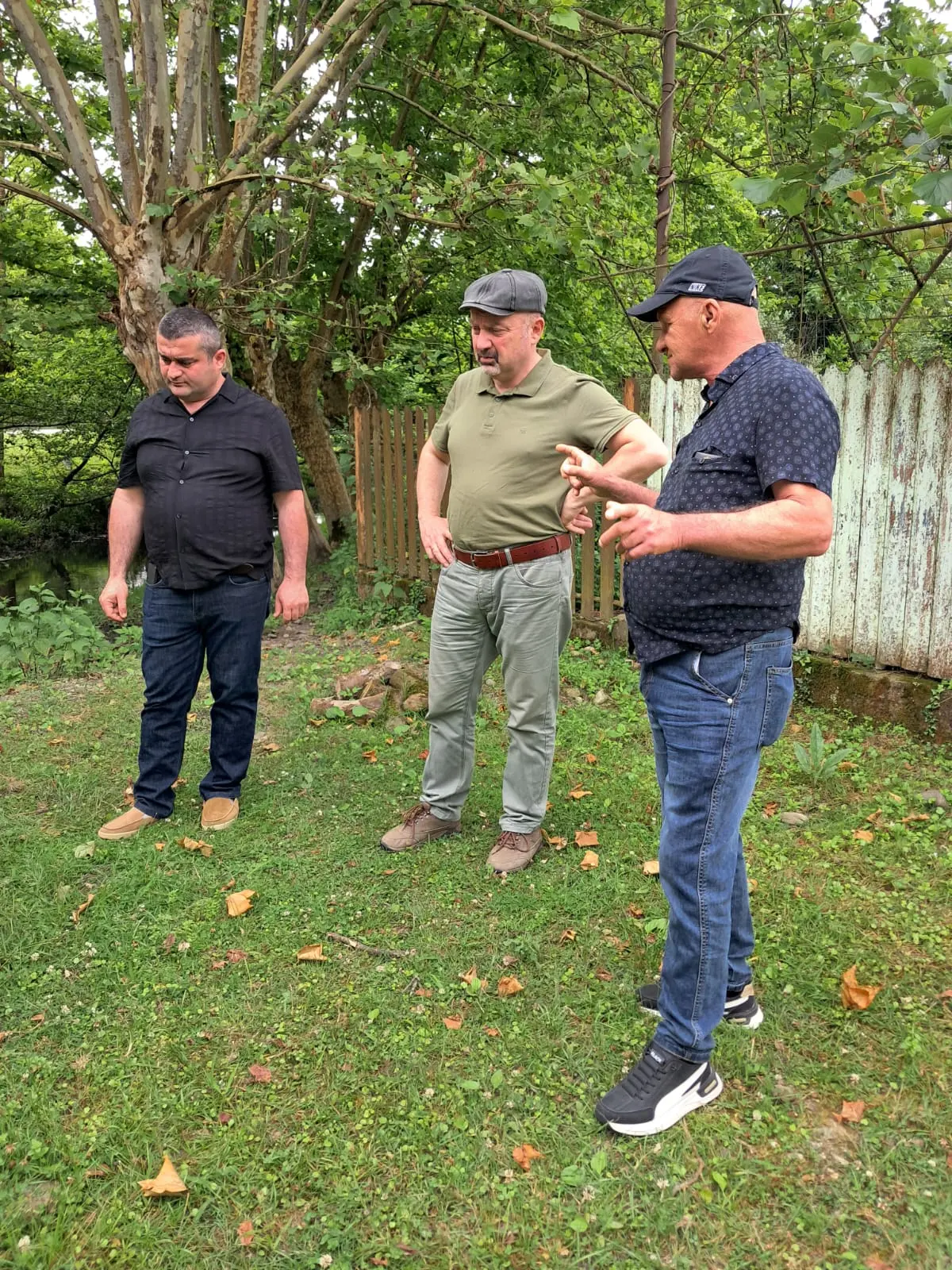
Photo: Hazelnut producers from the CaucasNut Organic Hazelnut Association at a meeting held as part of the project.

International Partnerships Austria funded by ADA

Disclaimer: The Austrian Development Agency (ADA) accepts no responsibility for the content of communication materials produced by partner organisations. The statements, opinions and information contained therein are solely the responsibility of the respective authors and do not necessarily reflect the position or stance of the ADA.